Debtless
Debt payoff tools fail because they focus on math, not emotion. Debtless uses calm design to lower financial anxiety.
Toronto, CA — 23 — SCAD '26
I don't just talk about ideas; I code them. From AI tools to financial systems, I turn "what if" into "here it is."
Video is my home base. I document the messy middle, translating complex systems into human stories.
Systems should be built for bad days, not just best days. I advocate for shame-free productivity.
Specification Sheets
Debt payoff tools fail because they focus on math, not emotion. Debtless uses calm design to lower financial anxiety.
A full-stack AI platform that turns founder recordings into LinkedIn posts, branded carousels, lead magnets, and analytics. End-to-end — from voice memo to auto-published content.
Granola got the form factor right — invisible meeting notes that write themselves. But it lives on macOS only and treats every meeting like a transcript. Oats is the opinionated cross-platform fork: structured memory, not just text.
A personal net worth tracker built like a science notebook. Plug in your accounts, track every asset class as a measurable variable, and watch your financial position compound over time. No hot-takes — just the data.
Most golf apps are scorecards with ads. FairwayOS treats your handicap like a sports analytics problem — track every shot, surface the patterns that are actually costing you strokes, and prescribe what to practice next. Coach in your pocket.
Premiere and Final Cut were built before transformers existed. Stitch is what video editing looks like when an agent is the primary user — describe the cut, the agent assembles it, you nudge it. The timeline becomes the conversation transcript.
An AI-powered financial operating system disguised as a debt app — built for people who feel crushed by their spreadsheets. The vision: Jarvis for your money.
December 31, 2023. A pho shop, a pen, and my brother across the table. We'd just spent the day talking about why every finance app we'd ever touched felt like homework — spreadsheets with anxiety built-in, dashboards that made you feel behind, budgeting tools that moralized at you for buying coffee.
By the end of dinner we had a sketch on a tissue. The core idea: what if the thing felt less like a spreadsheet and more like Jarvis — calm, competent, always on your side, never lecturing. Something you actually wanted to open.
Debt is already emotionally heavy. Turning it into Duolingo for shame is the wrong instinct. Clarity over pressure. Support over guilt. Steadiness over streaks.
— The Debtless principleEvery existing finance app lives somewhere on a spectrum of cold and fragmented. They'll happily show you how much you owe, and remind you what you spent. What they won't do is help you move forward. They track — they don't coach.
Debtless flips this. The AI coach is the product. Everything else — the dashboard, the planner, the charts — exists to give the coach context. The hypothesis: if opening the app feels like talking to a competent friend instead of staring at a guilt spreadsheet, people will open it more. And if they open it more, they pay it down faster.
I made a list of things Debtless would never do. The list is load-bearing — it's what the product is as much as what it isn't.
A conversation, not a checklist. Knows your situation, answers in plain language, refuses to lecture.
Snowball or avalanche — pick the one that fits your brain. Projected payoff dates update as life changes.
Progress, not percentages. You see momentum building — not how far you still have to go.
How you feel about your money matters as much as the number. The coach tracks both.
Debtless has been submitted to the App Store twice and kicked back both times — not for the product, but for polish on the onboarding flow, which is what I'm rebuilding right now. A real user's first thirty seconds matter more than any feature, so it's getting the attention it deserves before the third submission.
Debtless starts with debt because that's the most emotionally loaded part of personal finance — solve that and you've earned permission to help with everything else. The roadmap: budgeting, investing, life planning, all running through the same calm coach. The long version of this company is an AI financial operating system, not a debt tracker.
A founder memory system disguised as a content platform. It turns voice dumps into a reusable knowledge base of claims, stories, frameworks, and proof — then packages them into LinkedIn posts, carousels, lead magnets, and newsletters.
The pattern kept showing up. I'd sit down with an operator-brained founder — someone with real expertise, strong opinions, years of scar tissue, a genuinely interesting way of seeing the world — and they'd talk for twenty minutes and say ten sharp things, any one of which would've been a good post.
And then nothing. The post never got written. Their LinkedIn was a graveyard. The gap between "this person is incredibly smart" and "their internet presence does not reflect that at all" was huge and it was everywhere. Not because they didn't care — because the path from "a thing I believe" to "ready-to-publish content" is slow, manual, and breaks the moment real work gets busy.
Content is downstream. The durable thing is the smallest reusable unit of insight — a claim, a story, a framework, a metric. That's what "atoms" means.
— Why the metaphor stuckAtoms changes the unit of work. Instead of "write a post," the founder does a weekly voice dump — ten minutes of unstructured talking about what happened that week. Everything else happens downstream.
The system doesn't just extract "ideas." It classifies them. A claim is different from a story is different from a framework. Each type earns its own treatment downstream — confidence scores, post-potential ratings, and proof tiers that track whether an atom has the receipts to stand on its own.
Ten minutes of unstructured talking. No script. No slides. Founder hits record — the system handles the rest.
Custom RAG + Claude Agent SDK parses the transcript into discrete atoms and classifies each one with confidence and proof scores.
Every atom is embedded and persisted. The system builds a durable knowledge base of the founder's voice, ideas, and receipts — not a scratchpad.
One atom becomes a LinkedIn post, a branded carousel, a lead magnet, a newsletter snippet. Reuse without repetition.
Every draft is calibrated to the founder's actual voice. The rule: distill and amplify what's there — never invent the founder.
Isolated workspaces per founder. Matt's atoms don't bleed into Ryan's, and each one has its own voice model and pipeline.
Approved drafts flow straight into the scheduler. The pipeline runs on autopilot — the founder just approves.
Engagement data feeds back into atom selection. The system learns which ideas land and surfaces more like them next week.
People keep asking if it's "just ChatGPT with extra steps." It isn't. These are the lines I keep having to redraw:
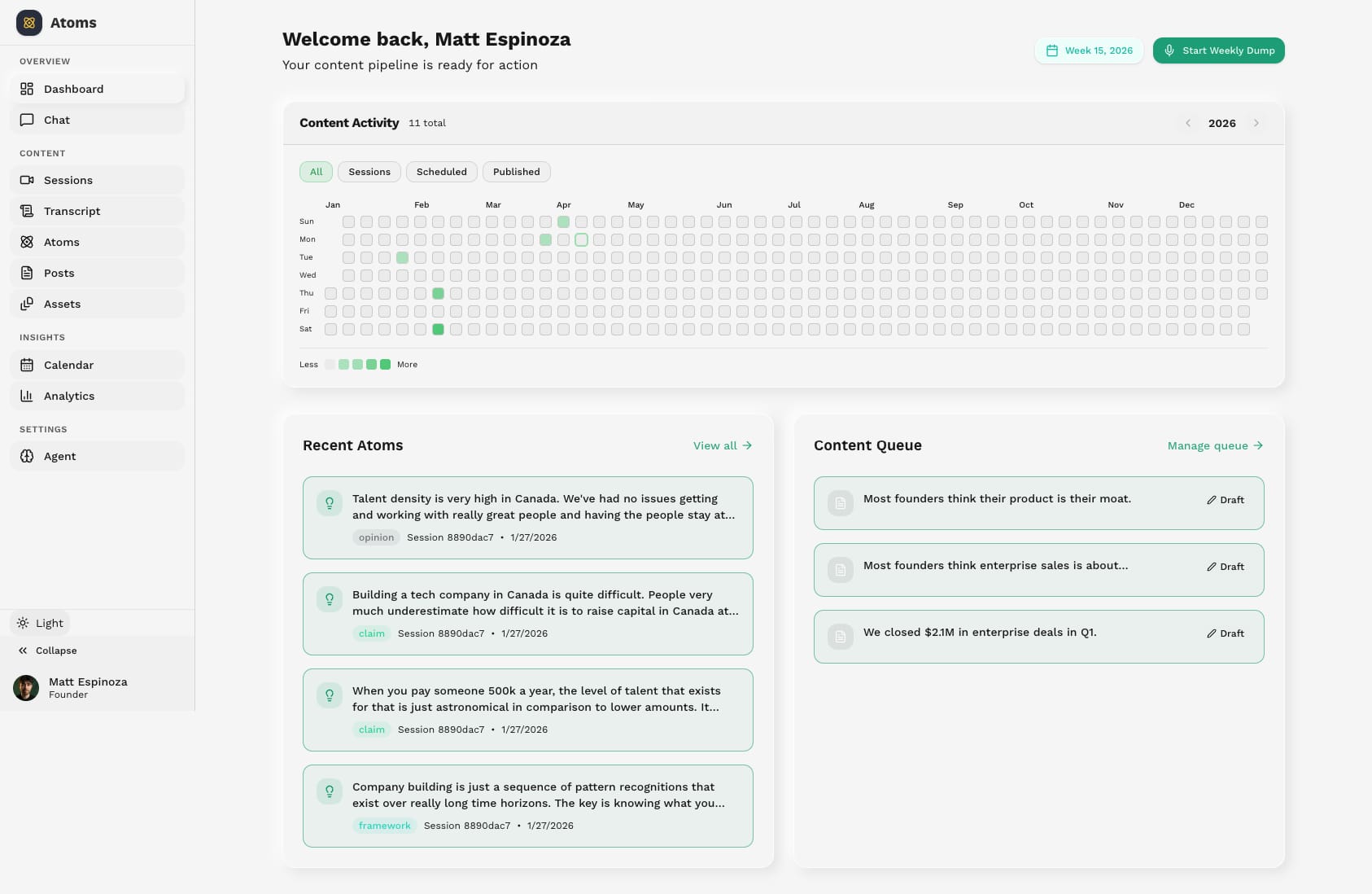
Recent atoms on the left — already classified by type, tagged with the session they came from. Content queue on the right — drafts already generated, waiting for approval. The contribution heatmap up top tracks every touch.
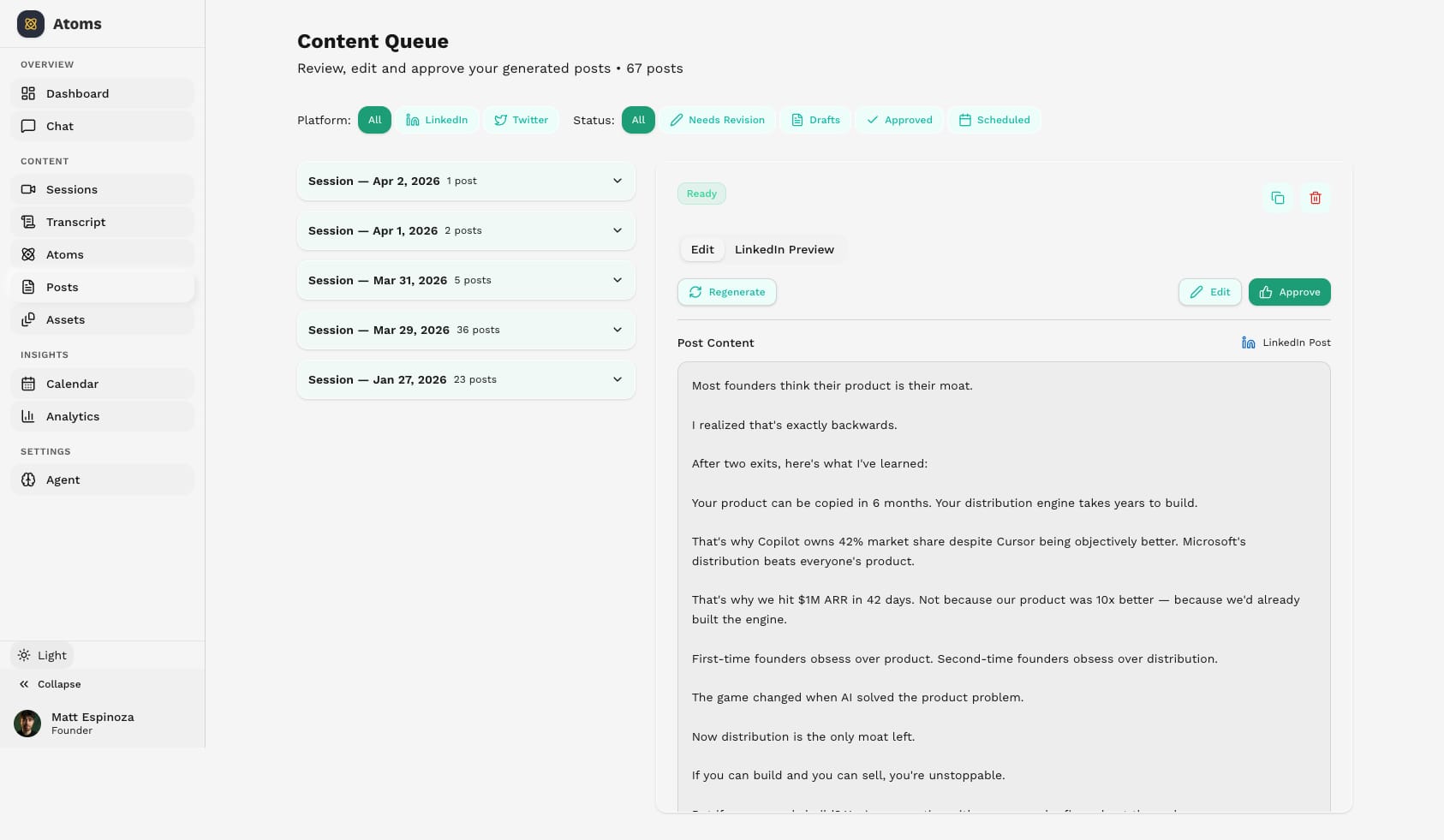
Generated posts pile into the queue grouped by session. Edit inline, regenerate, or approve. Approved posts flow straight to the scheduler. The founder is the only human in the loop — and only at the approval step.
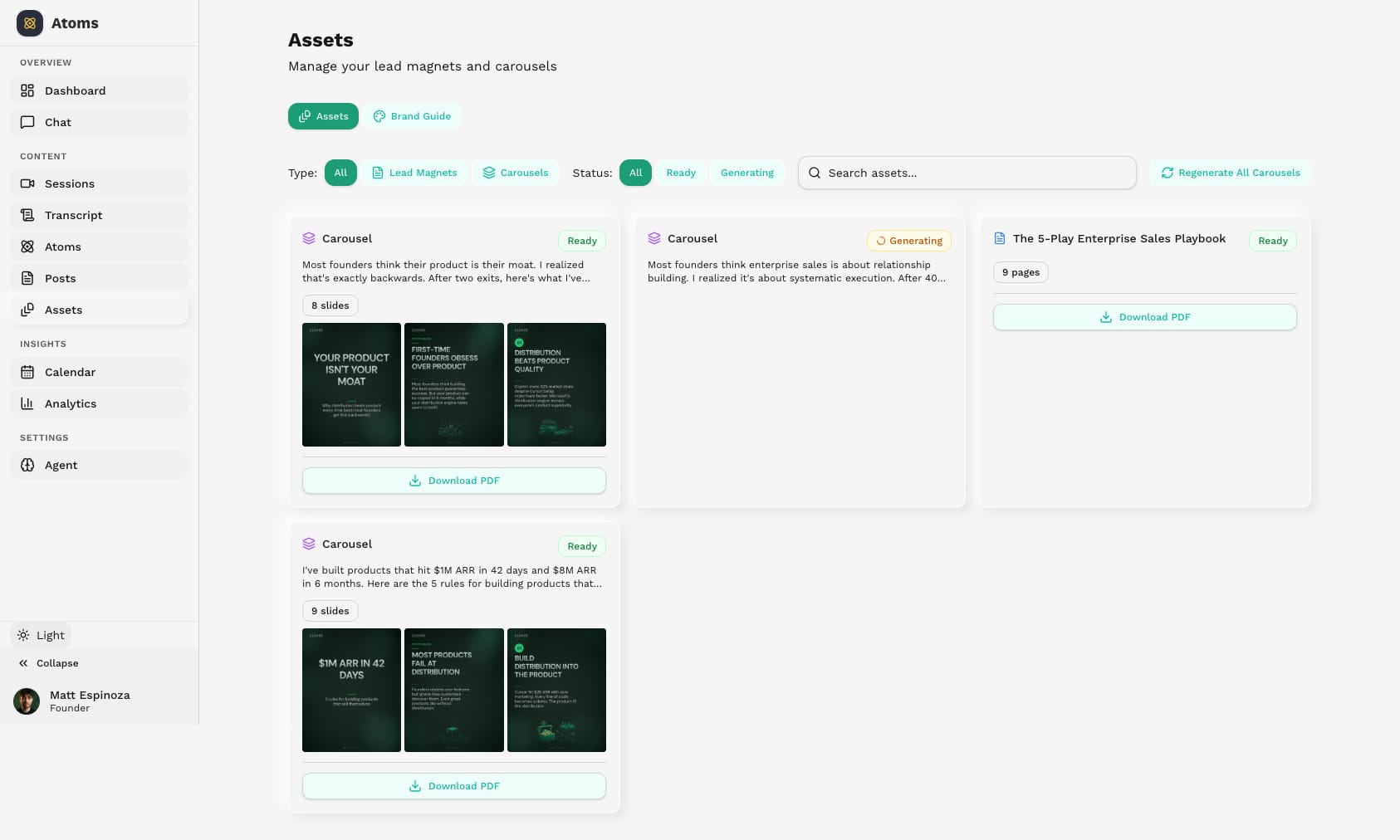
Atoms doesn't just write posts. It packages claims into branded carousels and frameworks into long-form lead magnets. Every asset is generated, tracked, and downloadable as a PDF — all from the same underlying atom layer.
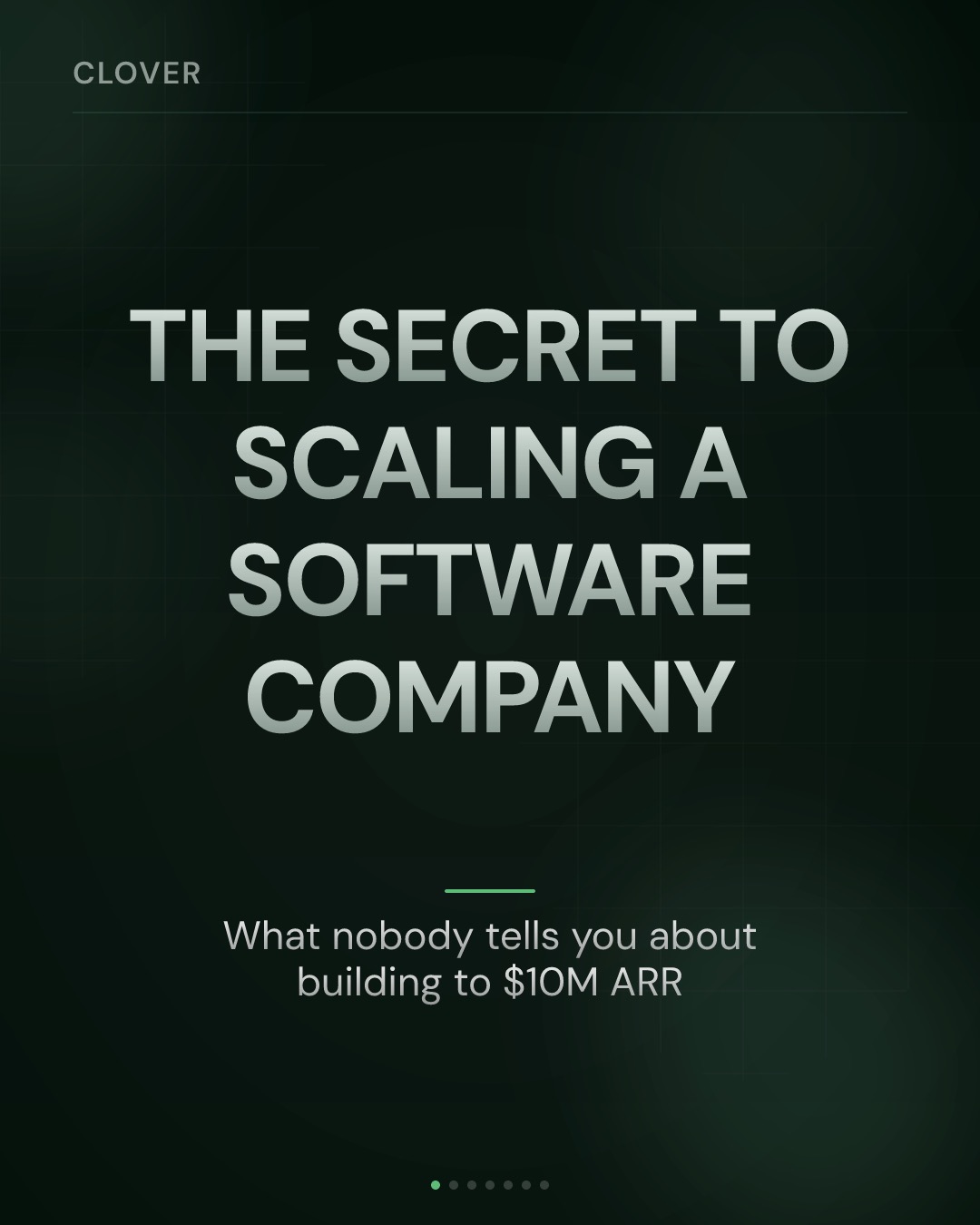
Two PDFs the system produced from real voice-dump sessions. Click to download — these are the actual files, not mockups.
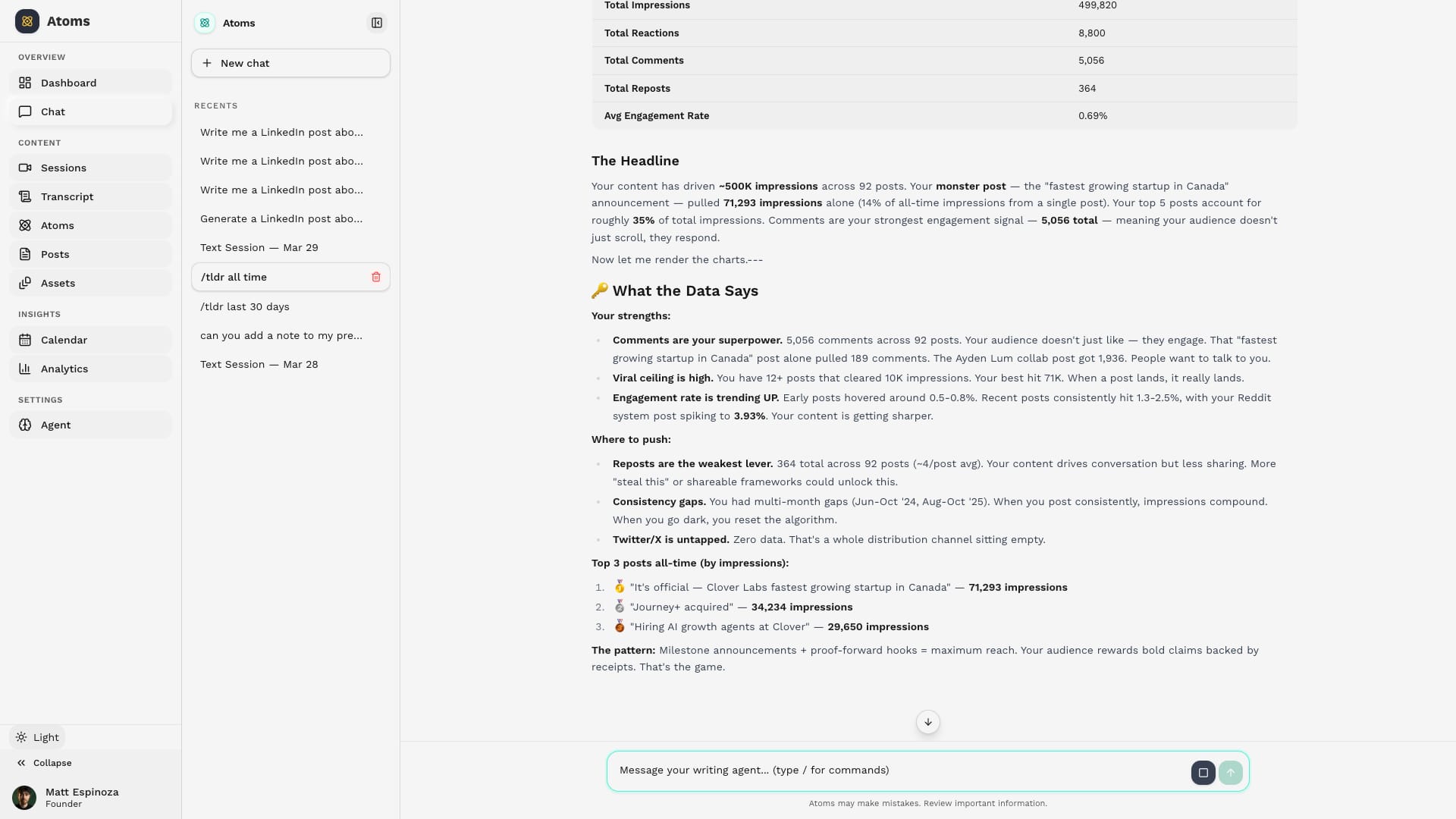
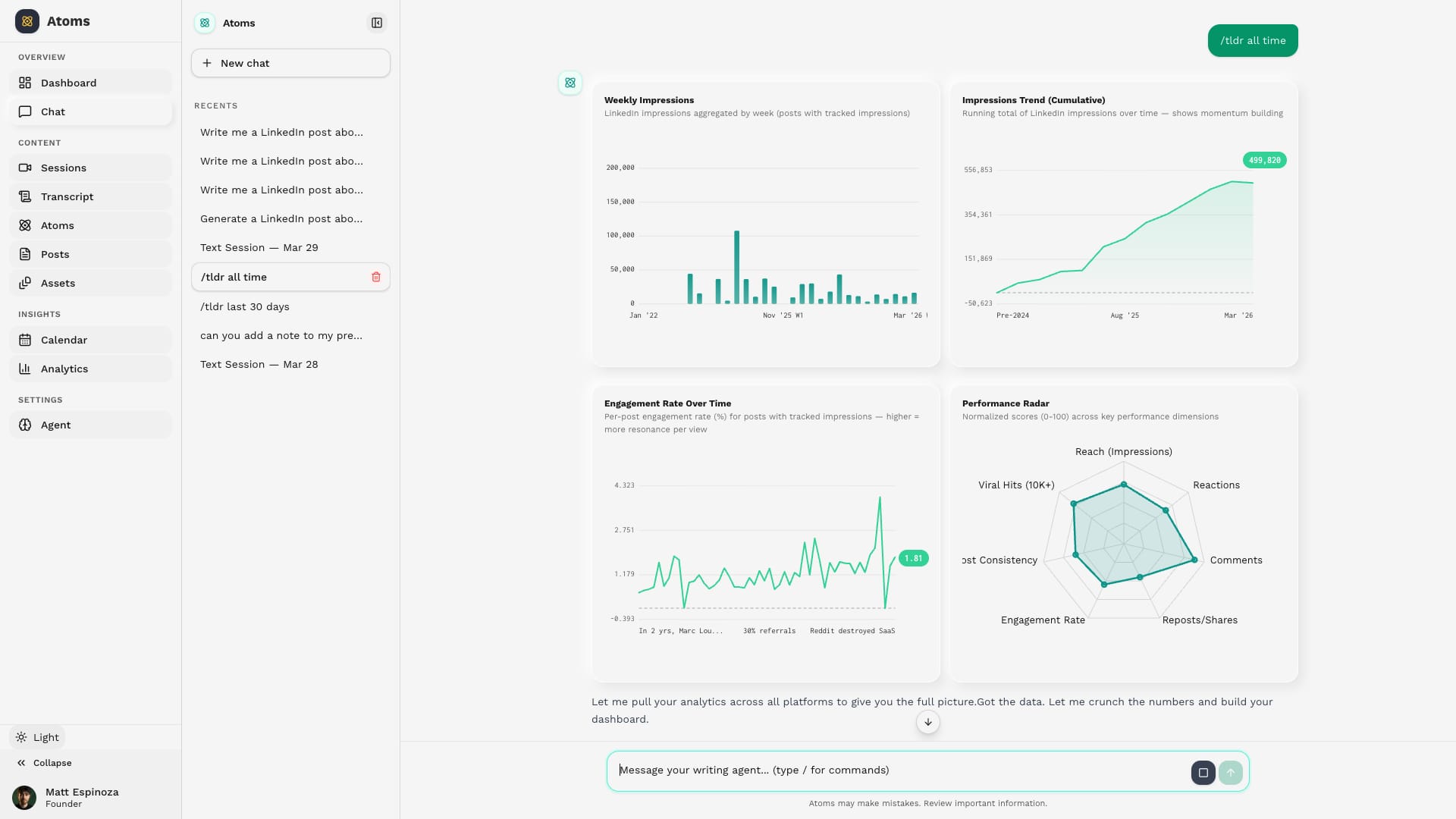
Every atom is embedded. Every post is tracked. The agent runs in-line — drop a slash command and it'll read your full history, score what's working, surface the patterns, and even render charts inside the conversation.
Atoms is currently in active private beta with a small roster of founders — not self-serve, not open, intentionally narrow so the voice models stay high-quality while the memory layer gets battle-tested. The screenshots above are from a workspace running in production right now.
Right now the system extracts, drafts, and schedules. The next horizon is autonomous content ops — agents that also research, package, cross-reference past atoms, measure what's working, and adjust the pipeline without being told. The long version of Atoms isn't a content tool. It's a founder's second brain that happens to publish.
A cross-platform fork of Granola — invisible meeting notes that live everywhere you do, structured as memory rather than transcript.
The full write-up is still in the lab. The short version: Granola got the form factor right — the AI listens, you keep typing your own notes, and at the end you get something useful. But it's macOS-only and treats every meeting like an isolated transcript. Oats is the opinionated rebuild: cross-platform from day one, local-first, and structured as memory — meetings link to people, projects, and decisions, not just timestamps.
When this entry ships, it'll cover: why Granola's macOS-only constraint is a moat AND a ceiling, how local-first transcription changes the privacy story, the structured-memory data model, and the part I haven't figured out yet — what to do when two meetings contradict each other.
A personal net worth tracker built like a science notebook. Plug in your accounts, treat each asset class as a measurable variable, and watch your financial position compound over time.
The premise: every existing net worth tracker is either a budgeting tool with charts bolted on (Mint, YNAB) or a wealth dashboard for people who already have wealth (Wealthfront, Empower). I wanted something between — a clinical instrument. No advice, no nudges, no gamification. Just here is your position, here is the trend, here are the variables that moved it.
When this ships, it'll cover: the variable-based data model (every account is a tracked variable with units, frequency, and a confidence interval), why Plaid is the right primitive even though I hate the UX, the SwiftUI + SwiftData architecture, and the philosophical question — is it the tracker's job to make you save more, or just to tell you the truth?
A handicap tracker that treats your golf game like a sports analytics problem. Track every shot, surface the patterns costing you strokes, prescribe what to practice next.
Most golf apps are scorecards with ads. The best ones (Arccos, Shot Scope) require buying $300 of grip sensors. I want something in between — a phone-and-watch-only solution that uses HealthKit motion data plus self-reporting to build a useful shot model. The goal isn't to track everything; it's to track just enough to find the two or three things that, if I fix them, drop my handicap by a stroke.
When this ships, it'll cover: why "strokes gained" is the right metric and how to estimate it without expensive sensors, the WatchOS UX problem (you can't pull out a phone after every shot), the CoreML approach to clustering shots by miss-type, and the open question — does prescribing practice actually change behavior, or just create guilt?
What video editing looks like when an agent is the primary user. Describe the cut, the agent assembles it, you nudge it. The timeline becomes the conversation transcript.
Premiere, Final Cut, DaVinci — they were all designed for a world where humans manipulated every clip by hand. The AI features bolted onto them feel exactly like that: bolted on. Stitch is the inverse premise: build the editor around an agent from the foundation. The user describes the cut they want; the agent assembles a draft; the timeline is just a transcript of that conversation.
When this ships, it'll cover: why the "describe → draft → nudge" loop is the right primitive for agent-driven editing, how the timeline doubles as both UI and conversation history, the AVFoundation + MLX architecture for keeping it local, and the open problem I haven't cracked — what do you do when the agent's draft is almost right but you can't articulate exactly what's wrong?
Sony A7C Mark II · DJI Osmo Pocket 3 · DJI Mini 4
[02.1] Gallery
[02.2] The Archive
The full catalogue — every commercial, brand piece, short film, social cut, and frame I've shot. Click anything to play.
"Visuals are not just aesthetics. They are the packaging for the idea. If the packaging is messy, the idea gets lost."
— Design Philosophy
Monthly experiments & daily thoughts. No edits, just results.